

This is a teaching look at a plate, not a doctor’s prescription and not a personal diet. If you have kidney disease, are pregnant, or already follow a treatment plan, the protein portion is set by the doctor who follows you.
The weekday question is simple: how to build a plate so the protein lasts until the next meal, without weighing every crumb. The reviews do not answer it with a thirty-minute “window” after the gym. They answer it with how much protein the day holds and how that protein is spread across meals. A palm on the plate is the kitchen way to keep that portion when there is no scale. It is not a laboratory dose in grams.
What the reviews measured, not a portion advert
The 2017 position stand of the International Society of Sports Nutrition reads the trials this way: people who train with a load usually have enough for muscle growth in a range of about 1.4–2.0 g of protein per kilogram of body weight a day. For one meal the authors name about 0.25 g per kilogram, or 20–40 g of high-quality protein. Below that, later meals start muscle-protein synthesis less well. Above that, the same meal does not buy a second equal gain.
The 2018 systematic review by Morton and colleagues in the British Journal of Sports Medicine did not look at a plate. It looked at protein supplements on top of resistance training. Mass and strength did rise, and the curve flattened near 1.6 g per kilogram a day. One more scoop after a day that is already enough adds almost nothing. For a person who does not weigh food, the practical reading is this: several ordinary portions across the day beat one giant evening catch-up.
Schoenfeld, Aragon and Krieger, in a 2013 meta-analysis with the daily total matched, found only a small edge for protein straight after training. If the day is already built, chasing thirty minutes is not the main lever. Today’s pattern is the calm weekday.
Why half the plate is vegetables
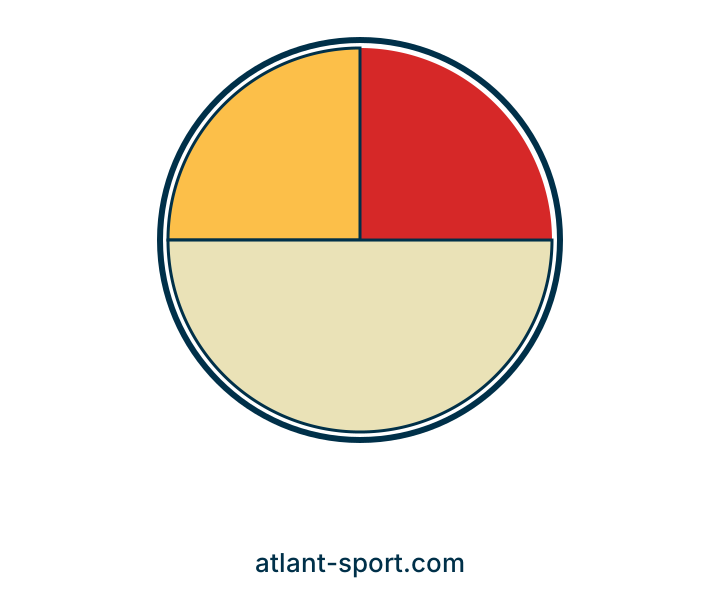
The Harvard Healthy Eating Plate and USDA MyPlate put vegetables and fruit on about half the plate. Grain is a smaller share. Protein is its own share, not the whole lunch. Juice does not stand in for the vegetable: a glass has neither the chewing nor the volume that carries you to the next meal.
Three ways to build the same day
| Way | What you do | What it rests on | Where it breaks |
|---|---|---|---|
| Palm and half a plate | Vegetables half, protein a palm, grain a handful | The Harvard and MyPlate shares, plus several meals a day as in the ISSN reviews | A tall person’s palm and a short person’s palm are different grams. A guide, not a doctor’s order |
| Counting grams | You weigh the food and count protein to the gram per kilogram | That is how the doses in Morton and the ISSN reviews are built | On a weekday the scale gets dropped. The day becomes bookkeeping, not lunch |
| All the protein at night | Salad and coffee by day, one large portion at night | The daily sum can still match a gram per kilogram | The reviews spread protein across meals. One late hit does not meet that condition |
The comparison does not pick one method for every person. Grams are sharper with a scale. A palm is sharper than eating until you stop, and coarser than a lab. One late portion loses if the rest of the day is empty.
How to build the plate with no scale
- Half the plate is vegetables: leaves, cucumber, tomato, cabbage. Not half a plate of potato renamed “a vegetable”.
- A palm is the protein: egg, cottage cheese, fish, meat, beans, or thick yogurt with no dessert.
- A handful is grain or a piece of bread. Not a second plate of side dish.
- Water sits beside the plate. Juice and sweet coffee do not replace the meal.
Alternatives when there is no chicken today
Egg, fish, meat, cottage cheese and yogurt cover the portion with no separate sports product. Beans cover it too, but the portion is usually larger than fish, not smaller. Nuts between meals are a handful for hunger, not a second lunch.
A calm day, as an example. Breakfast: eggs or cottage cheese, and vegetables. Lunch: fish or chicken, a handful of grain, salad. Dinner: beans or an egg, vegetables, a little bread. If you get hungry in between, yogurt. A second full plate “because three hours passed” is not in this pattern.
Where the pattern falls apart
Salad with no protein. All the protein in one late dinner. Juice instead of food. A palm you have quietly shrunk to two spoons because “that feels easier”. And the reverse: a palm that is already two, plus cheese in the coffee, plus a bar, and the day is no longer the one in the table. The pattern holds when three meals look alike, not when one of them “makes up for” an empty day.
The workouts on this site stay short instructions. They do not replace this piece. If the weekday plate is already built and you only need to move at home, the published plans next to it are a no-equipment circuit for the belly, twenty minutes in a small room, and one main move with a chair. They do not change the plate. They answer a different question: what the body does once the food is decided.
Sources
- Jäger et al. ISSN position stand: protein and exercise. Journal of the International Society of Sports Nutrition, 2017
- Morton et al. A systematic review of protein supplementation. British Journal of Sports Medicine, 2018
- Schoenfeld, Aragon, Krieger. Protein timing meta-analysis. Journal of the International Society of Sports Nutrition, 2013
- Harvard T.H. Chan School of Public Health. Healthy Eating Plate
- U.S. Department of Agriculture. MyPlate