
The question in “Ten thousand steps. What is worth keeping from that number” is whether 10,000 is a medical line you must cross. It is not. The useful answer is to keep the habit of walking more than a very low day, and to stop treating the round number as a cutoff. The papers below put the useful part of the curve well before 10,000 for many adults, and they never installed 10,000 as a diagnosis.
The round figure is older than those trials. It comes from pedometer marketing, not from a threshold a doctor drew. A Japanese step-counter sold in the 1960s was named for 10,000 steps. The name was a product, easy to remember and easy to print on a dial. What is worth keeping is the walking. What is not worth keeping is the idea that 9,200 is a failure and 10,000 is a pass.
What the step studies actually reported
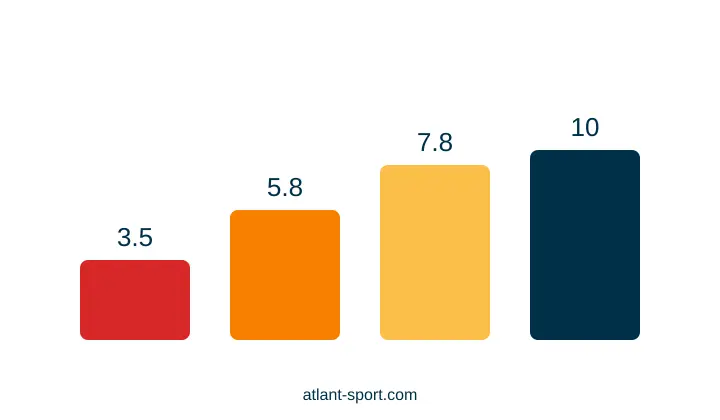
Paluch and colleagues pooled 15 cohorts in The Lancet Public Health in 2022. They split daily steps into quartiles. The median steps in those quartiles were 3,553, 5,801, 7,842 and 10,901. Against the lowest quartile, the hazard ratios for death were 0.60, 0.55 and 0.47. The risk flattened at about 6,000 to 8,000 steps a day from age 60, and at about 8,000 to 10,000 under 60. The top of the curve is a flattening, not a cliff at a marketing number.
Lee and colleagues, in JAMA Internal Medicine in 2019, followed older women. Mortality was already lower at about 4,400 steps a day than at about 2,700, and the benefit was largely in place by about 7,500 steps a day. More steps beyond that point did not keep buying the same drop. Saint-Maurice and colleagues, in JAMA in 2020, looked at 4,840 US adults aged 40 and older who wore an accelerometer. Compared with 4,000 steps a day, 8,000 steps carried a hazard ratio of 0.49, and 12,000 steps a hazard ratio of 0.35. After the total count was in the model, stepping intensity was not clearly tied to mortality.The count mattered more than the hurry.
Read as a set, the three papers agree on a slope and a flattening. They do not agree on a single ticket number, and none of them is a randomized trial that assigned people to 10,000. They are observational. The practical reading is still plain: leave the very low days behind, and do not invent a medical failure at 9,000.
Three ways to use a step count
| Option | What you do | What it rests on | Where it fails |
|---|---|---|---|
| Climb out of the lowest band | Move a 3,000-step day toward 6,000 to 8,000 | Paluch: the largest drop in hazard sat between the lowest quartile and the next ones | If the day is already past the flattening, more counting adds little |
| Match the count to age | Around 6,000 to 8,000 from 60, around 8,000 to 10,000 under 60 | Paluch’s age split, with Lee’s older-women curve leveling near 7,500 | Age is not a personality. A joint that hurts does not owe the quartile |
| Hit 10,000 or the day does not count | Walk in the evening only to make the dial round | A 1960s pedometer name, not a hazard ratio | The papers do not show a cliff between 8,000 and 10,000 |
The first option is the one most people actually need. The second is how to read Paluch without turning age into a rule for every body. The third keeps the marketing and throws away the curve.
What to do instead, and when the idea fails
Keep a watch or a phone count if it helps you notice a low day. Use it as a floor, not as a score you must round up. A walk that replaces a long sit is the part worth keeping. If you are under 60 and already near 8,000 most days, another lap for the last 2,000 is optional, not a medical debt. If you are over 60 and the day sits around 6,000 to 8,000, Paluch is not asking you to grind to 10,000. Intensity, in the Saint-Maurice analysis, did not add a clear mortality link once steps were counted, so a calm walk still counts.
The idea fails when the number becomes the workout and the joint pays. A sore foot, a knee that swells, or a dizzy spell is a reason to shorten the walk, not to finish the dial. It also fails when steps are the only training and strength never appears: walking and lifting answer different questions, and a high step day does not replace a squat or a press. It fails the other way when a person at 2,000 steps dismisses the papers because 10,000 feels impossible. The papers’ first gain is the climb out of that low band, not the last thousand.
Short published sessions sit beside the walk, they do not replace the count. Twenty minutes in a small room, fifteen quiet minutes for balance, and a home circuit are for strength and position. They are not a secret way to manufacture 10,000 steps indoors.
Sources
- Paluch et al. Daily steps and all-cause mortality: a meta-analysis of 15 international cohorts. The Lancet Public Health, 2022
- Lee et al. Step volume and intensity with all-cause mortality in older women. JAMA Internal Medicine, 2019
- Saint-Maurice et al. Daily step count, step intensity, and mortality among US adults. JAMA, 2020