
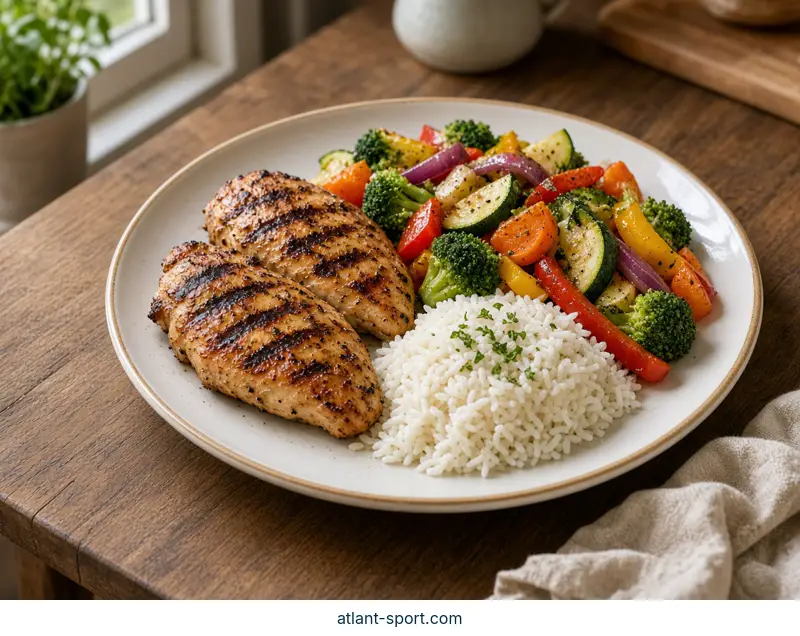
This is a teaching look at a plate, not a doctor’s prescription and not a personal diet. Kidney disease, pregnancy, or an existing treatment plan means a doctor sets the portion.
The question in “One extra palm of protein on a training day” is whether the plate has to become a second sports meal. It does not. The useful answer is the same plate as the calm weekday, plus one rule: do not skip the palm of protein at the next meal. A shake on top of a day that already has its palms is not required.
Training changes the session, not the shape of lunch. The next meal still has vegetables on half the plate, a palm of protein, and a handful of grain. The palm is the kitchen stand-in for the per-meal dose in the reviews. It is not a gram scale, and it is not a second lunch “because today was legs”.
What the feeding trials measured
The 2017 position stand of the International Society of Sports Nutrition, led by Jäger, puts a usual range for people who lift at about 1.4 to 2.0 grams of protein per kilogram of body weight a day. For one meal it names about 0.25 grams per kilogram, or 20 to 40 grams of high-quality protein. Below that, the meal starts muscle-protein synthesis less well. Above that, the same meal does not buy a second equal rise.
Morton and colleagues, in the British Journal of Sports Medicine in 2018, looked at protein supplements on top of resistance training. Gains in mass and strength rose, then flattened near 1.6 grams per kilogram a day. Another scoop after a day that is already there adds little. Areta and colleagues, in The Journal of Physiology in 2013, held the total still and changed only the pattern. Twenty-four trained men, eight in each group, took 80 grams of whey across 12 hours after lifting: 10 grams every 1.5 hours, 20 grams every 3 hours, or 40 grams every 6 hours. All three patterns lifted myofibrillar synthesis above rest, by 88 to 148 percent. The middle pattern, 20 grams every 3 hours, beat the pulse and the bolus by 31 to 48 percent. Same protein, better spread. That is the opposite of skipping the next meal and the opposite of stacking a second sports meal on a meal that already had its palm.
Three ways to eat on a training day
| Option | What you do | What it rests on | Where it fails |
|---|---|---|---|
| Same plate, palm at the next meal | Half vegetables, a palm of protein, a handful of grain, including the meal after training | Jäger’s per-meal dose and Areta’s 20 grams every 3 hours | A very small palm on a large body can sit under 20 grams. Then the day is short, not “trained” |
| A second sports meal | The normal plate, plus a shake or a second lunch because the session happened | Morton’s curve is already flat near 1.6 grams per kilogram | The extra meal adds food the reviews are not asking for once the day is covered |
| Skip the next meal | Train, then wait until a large dinner | The daily total might still look fine on paper | Areta’s bolus of the same 80 grams lost to the even 20-gram meals |
The first row is the change this page allows: nothing new on the plate, and no hole where the next palm should be. The other two are the common mistakes in opposite directions.
What to do instead, and when the idea fails
Build the training day the way the weekday plate is already described. Breakfast, lunch and dinner each keep a palm: eggs, fish, meat, cottage cheese, thick yogurt, or a larger portion of beans. The meal that follows the session is one of those, not a fourth construction. If training falls between lunch and dinner, dinner is the “next meal”. You do not insert a sports meal in the gap and then eat dinner as if the gap meal did not happen. Water is the drink. A sweet coffee is not the protein.
The idea fails when the day was already empty before the session. One palm at night does not repair three missed ones, and Areta’s finding was about spreading a fixed total, not about a single rescue portion. It fails when “do not add a second meal” is heard as “eat less than usual”: the palm still has to show up. It fails for anyone whose doctor has already set a protein limit. The note at the top is the rule there, not this table. And it fails if you weigh food and the palm is clearly far from the 20 to 40 gram band. Then the reviews’ gram range is the sharper tool, and the palm was only a stand-in.
The calm weekday pattern is already published as protein on a normal plate. The session itself, if you need one, is a separate page: press, row and squat across three days or six bodyweight chest steps. They do not change what goes on the plate.
Sources
- Jäger et al. International Society of Sports Nutrition position stand: protein and exercise. Journal of the International Society of Sports Nutrition, 2017
- Morton et al. Protein supplementation and resistance training. British Journal of Sports Medicine, 2018
- Areta et al. Protein distribution and myofibrillar synthesis after resistance exercise. The Journal of Physiology, 2013