
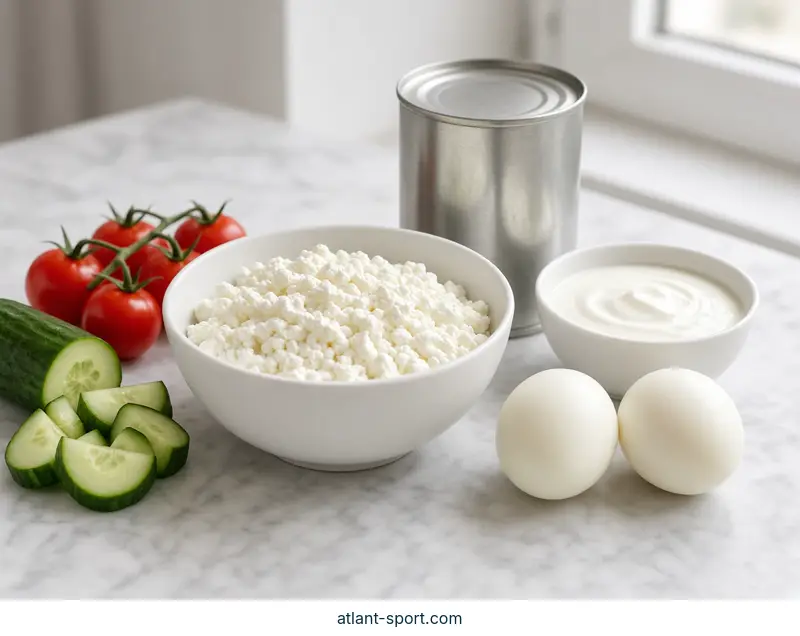
This is a teaching look at a plate, not a doctor’s prescription and not a personal diet. Kidney disease, pregnancy, or an existing treatment plan means a doctor sets the portion.
The question in “Protein from the fridge with the stove off” is how to keep the palm when the stove stays off. The useful answer is a short list you can take from the fridge or a tin: cottage cheese, eggs, yogurt, a tin of fish. Satiety comes from that palm plus chewing, not from a recipe. Half the plate is still vegetables when you can get them. No-cook is not no-plants.
The shape does not change because the pan is cold. Vegetables, or at least something you have to chew that is not the protein, take half. The palm is the cottage cheese, the eggs, the thick yogurt, or the fish. A handful of bread or leftover grain is enough starch. A bar with a long label is the spare, not the plate.
What still applies when you do not cook
Jäger and colleagues, in the 2017 position stand of the International Society of Sports Nutrition, did not write a special range for people without a kitchen. The day is still about 1.4 to 2.0 grams of protein per kilogram if you train with a load, and the meal is still about 0.25 grams per kilogram or 20 to 40 grams of high-quality protein. Eggs, dairy and fish sit in that “high-quality” band more easily than a sweetened drink with a protein number on the front. The stand’s point survives the missing stove: several meals, each with a real portion, beat one late catch-up.
The Harvard Healthy Eating Plate and USDA MyPlate draw the same main shares. Vegetables and fruit take about half the plate. Protein is its own share, not the whole meal, and not a shake that replaces the meal. Grain is the smaller share. Juice does not stand in for the vegetable, because a glass has neither the chew nor the volume that carries you to the next meal. A no-cook plate can follow that drawing. Cottage cheese with tomatoes, eggs with a carrot, yogurt with cucumber, fish from a tin with cabbage: none of those needs a pan, and each still has a half that is not the protein.
Three ways to skip the stove
| Option | What you do | What it rests on | Where it fails |
|---|---|---|---|
| Fridge palm and raw plants | Cottage cheese, eggs or yogurt, plus tomato, cucumber, cabbage or carrot on half the plate | Jäger’s per-meal portion and the Harvard and MyPlate half | If the only “vegetable” is a spoon of jam in the yogurt, the half is gone |
| A tin of fish | The fish is the palm, bread is the handful, leaves or pickled cabbage fill the half | Fish is a high-quality protein in the same stand, with no cooking | A tin at every meal piles up salt. It is a tool, not the only tool |
| A bar instead of a plate | One packaged bar and coffee, called lunch | The label may show 20 grams, which is inside Jäger’s meal band | There is no half-plate and no chew. MyPlate is not a wrapper |
The first row is the ordinary no-cook day. The second is the honest spare when the fridge is only the tin. The third keeps a number and loses the plate.
What to do instead, and when the idea fails
Stock the four foods and something that counts as the half. Breakfast can be eggs or cottage cheese and a tomato. Lunch can be the tin of fish, a piece of bread, and cabbage. Dinner can be thick yogurt and cucumber, or cottage cheese again if that is what is left. You do not need a new dish because the clock moved. You do need the palm at each of those sittings. If beans from a jar are the protein, take a larger portion than the fish: the same weight is not the same meal in the stand’s “high-quality” sense. Nuts are a handful between meals, not a second lunch.
The idea fails when “almost no cooking” becomes “almost no food”. Three spoons of yogurt are not a palm. It fails when vegetables vanish for days and the plate is only dairy: the Harvard half was not optional decoration. It fails on salt if the tin is breakfast, lunch and dinner. Rotate to eggs or cheese. It fails if a clinician has already set the portion, which is the note at the top, not this list. And it fails if you are hungry an hour later every time, which usually means the half was missing or the palm was a taste, not a portion. Add the plants and the palm before you add a second full plate.
The cooked version of the same idea is already published: protein on a normal plate. If the evening is also too short for a long session, the matching pages are one main move with a chair and twenty minutes in a small room. They do not cook the meal either. They just keep the day from being only the tin.