
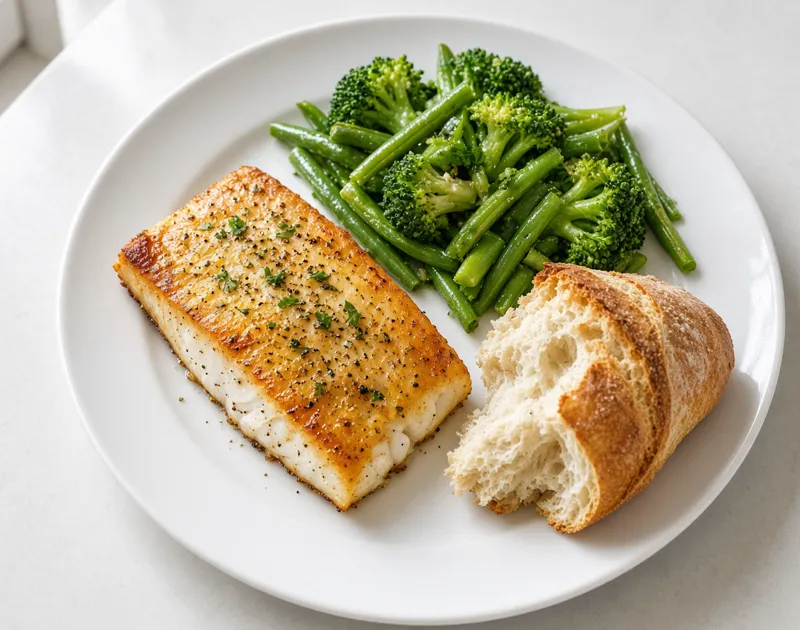
This is a teaching look at a plate, not a doctor’s prescription and not a personal diet.
You do not need an app that counts every crumb for a weekday. A palm of protein and half a plate of vegetables can carry an ordinary day without a log. The grams in the reviews tell you what that palm roughly stands for. They are not an order to weigh the parsley, and they are not a diet written under your name.
This page is not the calm plate piece already published. That page shows what an ordinary meal looks like. This one asks whether that meal must become bookkeeping. The answer is no, if the palm and the half plate show up a few times in the day. A log is useful only as a short check.
What the reviews count, not an app
Jäger and colleagues set out the International Society of Sports Nutrition position in the Journal of the International Society of Sports Nutrition in 2017. For people who train, they name about 1.4–2.0 g of protein per kilogram of body weight a day. Per meal, about 0.25 g per kilogram, or roughly 20–40 g. That is the language of trials. A trial weighs food, or the dose cannot be compared. A weekday does not have to become that trial.
The Harvard Healthy Eating Plate and USDA MyPlate draw shares, not a diary. Vegetables and fruit take about half the plate. Protein is its own share, not the whole lunch. Grain is smaller than it looks when the side dish wins. These pictures are exactly a look at a plate without counting every crumb. They do not ask for an app. They ask that the half plate does not vanish into one cutlet or one bowl of porridge.
A palm is a coarse translation of a 20–40 g portion, not a laboratory scale. A tall person’s palm and a short person’s palm are different grams, and the ISSN stand does not hide that, because the stand speaks in grams. For weekdays the other point matters more. Several portions across the day sit closer to 1.4–2.0 g per kilogram than one perfectly counted dinner after an empty day. An app can show the same thing. It does not create protein that was never on the plate.
Three ways to treat the counting
| Way | What you do | What it rests on | Where it breaks |
|---|---|---|---|
| Palm and half a plate | Vegetables half, protein a palm, grain smaller. You do not open an app | Harvard and MyPlate shares, plus several meals, as in the ISSN range | The palm is quietly shrunk to two spoons, and the day misses 20–40 g |
| Counting every crumb | You weigh and log everything, including the sauce and one leaf | That is how doses are built in the Jäger review. Grams per kilogram are not a metaphor there | The log is dropped by midweek. Lunch disappears with it, though the plate was still there |
| No picture and no log | You eat whatever is nearest and do not look for protein or vegetables | None of the sources named here. This is the absence of a pattern, not a third pattern | The day might hit the range by chance, or it might be coffee and a side dish |
The comparison does not call an app harmful. Scales are for places where doses are compared. On a weekday the plate share is more honest than a log that lives for two days. The third way loses to both, because it has neither grams nor a picture. If numbers calm you and you keep them, leave the log as a one-week check.
What to do and where the idea fails
On an ordinary day, build three meals that look alike. Vegetables take half, protein is about a palm, grain is not a second plate. That is enough to leave the app closed. If you want to see whether you are near 20–40 g, weigh the protein once and remember what that portion looks like. After that, use your eyes. Water sits beside the plate. Juice does not replace the vegetable, even if an app will file the glass as a fruit serving.
The idea fails when the palm becomes an alibi. Two spoons of cheese are not a palm. Half a plate of potato is not the vegetable half in the pictures. It also fails the other way. Someone counts every gram of protein and leaves the vegetables off because the app total matched. The ISSN range is about people who train. It is not a prescription for kidney disease, pregnancy, or a plan a doctor already wrote. A doctor sets that portion. This page does not stand in for that visit.
The plate itself, without the argument about an app, is already published as protein on a normal plate. If the stove is off, the neighbour page is protein with no cooking. That page is the fridge, not a log. They show what the meal is made of once you decide not to count crumbs.