
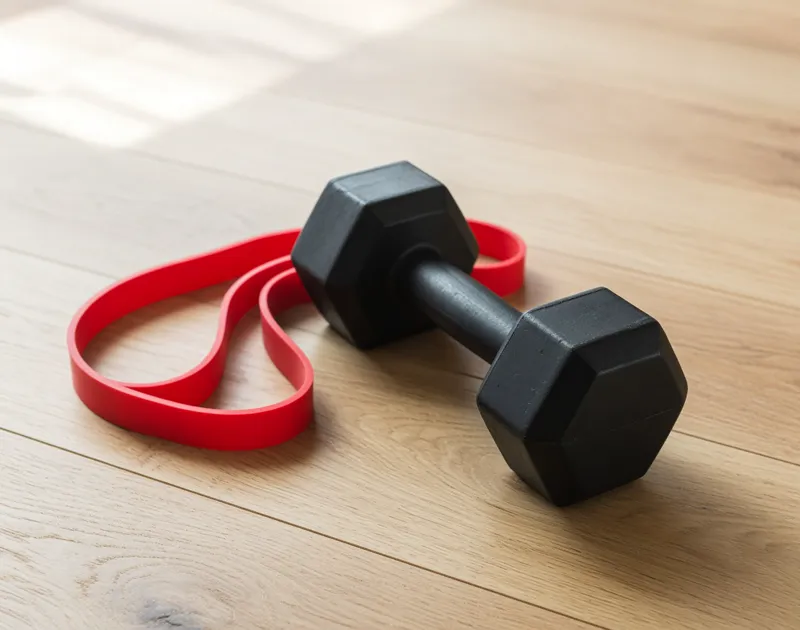
A band does not replace a machine as an object. On the strength short programmes measured, there is no winner either. Eight studies did not show elastic resistance beating machines or free weights, and they did not show the reverse. The tools are not the same. A band gets harder as it stretches, so count the hard end of the rep. On many machines the load stays closer to one number from start to end. Similar strength gains do not make the two tools into one.
On an ordinary day the answer is narrower than the slogan. If the gym is closed or the room is narrow, a band can carry strength work that would otherwise wait. If the job is a heavy squat or a press with a bar that stays put, the band does not become that bar. Keep the lift you can repeat cleanly. Do not call the easy start a plate that was never on the bar.
What eight studies actually found
Lopes and colleagues published a systematic review with meta-analysis in SAGE Open Medicine in 2019. The PubMed record is 30815258. They pooled eight studies of elastic resistance against conventional devices. After the corrigendum the review does not support superiority of either side.
The numbers are small, and the intervals cross zero. Lower limb SMD -0.11, 95% CI -0.40 to 0.19, p = 0.48. Upper limb SMD 0.09, 95% CI -0.18 to 0.35, p = 0.52. A result that contains no difference is not a win for the band and not a win for the machine. It reports similar strength gains in the pooled studies. It does not let you rename a cable exercise and call the swap finished.
The shape of the rep remains. On many machines the load stays near one number, or it follows a cam the maker chose. On a band the tension rises as the rubber lengthens. The first third can feel easy. The last third is where the band asks for strength. Count the hard end, not the easy start. Stop when that end shortens, the joint complains, or the hands let go and the band snaps back.
Three ways to get the same strength work
| Way | What you do | What it rests on | Where it breaks |
|---|---|---|---|
| A band, with the hard end counted | You pull so the finish is the hard part, and you stop while the path is still the same path | The Lopes review. Strength gains were similar. The tools are not identical | The band is so light the end never gets hard, or so stiff the start is already a yank |
| A machine or another steady load | The load is one you can name, and it rises only after clean reps | A number you can write down and compare next week | There is no gym, or the machine drives the joint along a path it will not take today |
| A band wearing a machine’s name | The exercise title is copied from a poster, and the changing tension is ignored | Only the slogan that a band replaces everything | The easy start is counted as a full rep, and the hard end is skipped |
The table does not rank people. It checks whether the tool in the hand is named honestly. The review allows either tool when the work is real and the reps reach the end. It does not allow a new name on the card in place of that work. If both are in reach, take the one you will finish with a quiet joint. If you only have a band, count the hard end, not a heavier story than the rubber can tell.
What to do and where the idea fails
One pattern is enough for a month. With a band and a small room, choose two or three moves you can finish while the hard end is still clean. A row, a press, and a squat or a hip hinge are enough. Inside eight to twelve reps, the last two should be the hard ones, not the first two. Rest so the next set stays strength work. Write the colour or thickness, the long reps, and whether the end was hard. Next week, earn one more clean rep on that band before a thicker one.
The idea fails in plain places. Joint pain is a stop, not a hard end. A band that slips off a door is not a station. A set that exists only because you shortened the stretch will not compare later. Heavy work that needs a bar in small steps is another tool. Eight studies do not turn a light band into that bar. Use the band through the end of the rep, or keep the machine if its path is already clean.
Two published sessions already live where a band usually earns its place. Twenty minutes in a small room is the short session when the floor is tight. One main move with a chair is one pattern and a place to sit between efforts. Neither page says a band is a machine. Finish the rep you can repeat.